Tuesday, 21 April 2015

Moving house - easy peasy lemon squeezy

The last week has been mental. We could sleep for another week.

Last Monday brought further trips to storage, trips to the tip, trips to storage and trips to the tip. There were forays in to the loft, avalanches of boxes out of the loft, trips to the tip and rooms stuffed with boxes. It turned out that 15 years of Dawn storing anything that she wasn't sure what to do with in the (rather large) loft was a very, very bad idea. Half of the stuff we've eventually sent to storage or taken to The Lodge is still destined for the skip.

Boxes. Everywhere.
The days before and after last Monday all blur in to one, if I'm honest, but they involved at least two days shifting two of the most enormous monolithic garden ornaments the world has ever seen - a five-foot rough-hewn slate water feature weighing-in at half-ton that I neither like nor want, and the one-ton base of a rough-hewn stone table that I like but never sit at. The hefty table top and its five lardy stone stools were manhandled to The Lodge's garden in the days before we got the keys with the generous assistance of our friend Andy, his Landy, an engine hoist and a bouncy trailer.
Andy and Dawn slay giants.

Two days were spent burning to a crisp in the sunshine as I demolished what had been a chicken enclosure in The Lodge's front garden but was left to rot for many years afterwards. I ended up with a lovely pile of rotten firewood, big bundles of lethal chicken wire and a dozen sheets of long corrugated iron that I've put to one side for a future project.
This former chicken paradise, which is now overrun with stinging nettles and bricks, is earmarked for our 20ft x 10ft workshop and I wanted to get some of the knackering time-wasting work out of the way early.


I'm now going to introduce you to Trevor. 
Bokbokbok. The ex-chicken enclosure.

Trevor is Dawn's 73-year-old dad and Trevor is a machine. Terminator Trevor.
Despite having 30 years on me, this man can drive anyone to the point of exhaustion and still keep grafting after the ambulance has left. He had me in tears.
It started gently with a lads' day out at The Lodge before we got the keys, securing the garage doors so we could safely store bits and bobs when moving day finally came. It was a grand day, just the two of us in the sunshine and lots of boob jokes and farting. That's not true, but there were ham sandwiches and KitKats.
By the end of the third day together we had a Luton van and Terminator Trevor, undeterred by the previous two 13-hours days of lifting, carrying and throwing things around, had loaded almost the entire contents of the garage - aka The Loft Overflow - along with the contents of the garden, including two sleepers, eight half sleepers, piles of breezeblocks, left-over stone driveway blocks and blue bricks, a cast iron chimnea and God knows what else. When Dawn came home from work Terminator Trevor was sent home shortly before I asked if he was on speed, and we headed to The Lodge where we unloaded and went for a Maccy Dees.
Then came more loading and unloading, with Terminator Trevor charging valiantly forth - he's got a long caravan holiday coming up in a few days and he's ODing on Jobs To Be Done NOW. And, lo! Jobs were indeed done.

Somewhere in the melee of Jobs That We Did there were keys and exchanges and completions and stuff and me and Dawn moved in to our now-old neighbour's house - right next door to the house we'd just sold. Which was somewhat awkward. And we plan to stay a week at least.
Having been forced to store some things that we couldn't fit in to the Luton for its third trip in our neighbour's front garden, we found ourselves in the peculiar position where we were loading a van on the driveway there while, at the very same time, our buyer moved her things from a van in to our old house. Life just doesn't prepare you for situations like that. She even put an ornament on our old spare room windowsill that said 'HOME'.

Then came more unloading and more jobs, with able assistance - and often great leadership - from Terminator Trevor and Andy with the Landy.
In no particular order:
Trevor lets the young 'uns have a go
  • The removal and ritual burning of all of the manky, damp rubber underlay from throughout The Lodge. The very much mistaken idea was to obliterate mould, germs and other nasties rather than have it all hanging around before we're ready for a skip. To punish me for the billowing black clouds that are still giving orangutans a chesty cough in Borneo, karma sorted me out. I'll mention injuries in a moment.
  • A cat flap was installed in the back door inside the courtyard. We didn't put one in the gate in to the courtyard, however, because we want to give SausageTheCat a bit of a challenge.
  • The chicken enclosure area was dragged with a JCB digger, driven by yours truly (and a bit by Andy), creating a level-ish weed-free-for-now section of garden on which the workshop will go.
  • Two new soft-close toilet seats were fitted and the loos were bleached and scrubbed to within an inch of their lives. Old bum germs be gone.
  • We unearthed a well (full tale below).
  • A leaky radiator valve was changed in the kitchen.
  • Removal of concrete mortar pointing was started towards the back of the house. Done by hand, this will be a long and time-consuming job that may as well be done piece-meal until we can dedicate some time to it. It's a start.
  • Removal of the non-breathable paint from above the external window lintels was started. Again, done by hand. Chip, chip, chip, chip.
  • The side entrance door to the garage got a new lock fitted.
  • The damaged breather from the septic tank was rescued with chicken wire to prevent external crap from getting in.
  • Door handles were fitted throughout because much of the door furniture had mysteriously gone missing.
    Man tools are for men.
  • SausageTheCat started making trips with us to The Lodge to get him out of our old neighbour's house and start introducing him to his new home. He's found his place on the living room windowsill already but he doesn't like stinging nettles. He also doesn't like it when Andy's SamTheDog comes around. I'll mention injuries in a moment.
  • The kitchen cabinets were moved along one of the walls to accommodate our new induction Rangemaster when it comes in a couple of weeks. It's the one luxury we're affording ourselves now because we'll be able to incorporate it in to whatever our kitchen later becomes.
  • The water standpipe in the courtyard was moved.
  • Kitchen pipework was reconfigured for the repositioned sink.
  • The bottom of the back door was planed down to save it from sticking on the floor and having to be booted for a full minute before it would open.
  • All of the useless woodwork on the outside of The Lodge was removed, namely the rotten wooden planters along the side and the trellis work at the front which was supporting a ton of dead sticks that were invading the roof joists. Terminator Trevor wasn't happy about that because, apparently, they weren't dead after all and would come out nice in the summer. All they needed was a trim. Meh. But they looked dead in the meantime.
    Where the workshop will go
  • Some slates on the garage roof were replaced and some rotten beams in the outbuildings were repaired.
  • We took delivery of the workshop. We just need a few more things and we should be ready to go mid-week.
  • We made friends with the neighbours along the track (they've loaned us their digger!), chatted to some neighbours from a bit further afield and some random strangers and got to know our postie and bin men - important allies!
Finally, today we started levelling the tiles that'll form the base for the workshop. They're grids that hold decorative gravel which will double as drainage, on which will go sleepers and then the structure.

The eagle-eyed among you, dear readers, will notice that we found a well. We did.
Well I never, etc.
I unearthed the edge of a metal disc with the digger when my bucket caught on the rim, let go suddenly and catapulted me forwards in to the windscreen. I'll mention injuries in a moment. Careful digging a-la Time Team revealed a large and heavy wrought iron well cap, about 5ft in diameter, attached to which were the footings for the pump which is probably in the overgrown grounds somewhere nearby.
We dropped a stone through a small hole in the centre, heard it hit bits of metalwork on the way down, then... silence. Then a distant sploosh.
I found a heavy Varta Indestructible torch and all the rope, gaffa tape and zip ties I could get my hands on and started lowering it down. I ran out of rope. So I attached the plug end of a 20m extension lead and lowered that down too. It wanted to keep going. So I pulled the whole lot up and measured it - a whopping 250ft in total, with the final 50ft having been submersed in freezing cold water. Superb!
We're booking Andy for help with the workshop on Thursday and, being a search and rescue hero, he has lots of rope. Smiley face.

More details when they come in...

INJURY COUNT

Dawn - 0
Trevor - 0
Andy - 0
Muz - 4

  • A slice down the pad of my left index finger when a flake of paint I that I decided to rub off the engine hoist turned out to be a razor-sharp piece of steel.
  • A scratch along the length of my left thumb, suffered when I tried to save SausageTheCat from SamTheDog.
  • Minor concussion and moderate whiplash (probably) when an incident with a wildly-flailing digger saw me catapult in to the inside of the windscreen.
  • Multiple burns up the side of my left forearm. This is what happens when you flick burning underlay upwards, trying to get it in the burny bin properly. The molten rubber underneath tends to melt and set fire to anything it touches. Sad face.
Karma

Saturday, 18 April 2015

Getting rid of mould

Living in a house with mould is bad for your health. Living in a house with mould stains - where you’ve cleaned the mould, but it’s left really annoying black marks behind, is also irritating, not to mention embarrassing. The tenant(s) who lived in The Lodge before we did must have had cast iron lungs. And no shame.

Corners of the Lodge were covered with black mould (including a small amount of the really toxic variety) and stains, and I started wheezing on the survey day after spending more than an hour inside without a mask. 

So although stripping the wallpaper is high on the to-do list, killing the mould spores before we managed to shake them into the atmosphere was a number one priority, and one we wanted done sharpish. Plus, getting rid of evidence of mould before the mortgage valuation seemed like a sensible thing to do.

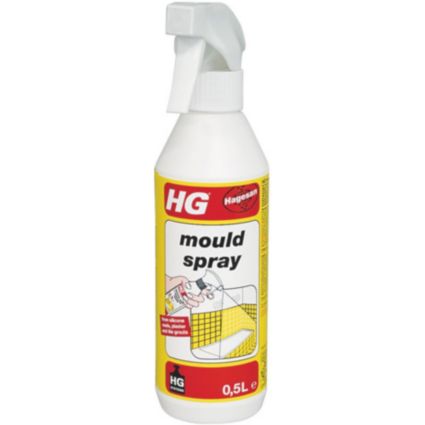
Enter my new favourite product: HG Mould Spray.

I'd found this after searching the internet for recommendations when a previous home had condensation problems, and from that search it appears I’m not alone in thinking it’s a bit awesome. 

The spray not only kills mould, it also obliterates the stains that mould so often irritatingly leaves behind, handy when a mortgage survey is due to take place! You can buy it online or from various DIY-type shops – we got ours from our local B&Q for a fiver.

To apply, I squirted a liberal dose on all the mouldy areas in the Lodge (there were a lot), threw open all the windows, and went outside to partake in some fresh air. 


Before...
After half an hour I headed back inside and wiped the walls down. I found that on purely painted surfaces every single trace of mould and stain completely disappeared. 

On the wallpapered surfaces some minor marks were left behind. I could have treated these a second time, but as we're removing the wallpaper, there wasn't much point - the mould itself is gone and I'm happy with that.

...After
This recommendation comes with a warning though – this is one of those products where you should pay serious attention to the label. When it says don’t get it on metal, it means it – the first time I used it I was wearing a silver ring while spraying it, and the spray started eating it away. Wear old clothes too – I also managed to get a bleach mark on the top I was wearing. (I am known for being clumsy!)

I also strongly recommend wearing a mask and opening windows, it’s not exactly lung-friendly stuff.

Friday, 17 April 2015

Keys! And a celebratory hygrometer reading...

We now officially own The Lodge!

After the period house survey took place and we were happy with what we were taking on, the final hurdle in our eyes was the mortgage valuation survey, which took place pretty quickly after the mortgage details were agreed and six agonising days later our mortgage lenders called to say that they were happy! 

The survey had highlighted only that there was ‘localised higher than desirable damp’, so recommended a damp and timber survey. And the lenders are happy to leave that up to us, provided we do it, and then address whatever issues are raised within six months. And they don’t need us to send the actual report in, though our period house surveyor has offered to do one for us, as he'd highlighted the problems to us in the first place.

Here's the initial hygrometer reading in The Lodge, coming in at a humid 75%, highlighting the immediate challenge we face.

For more on hygrometers and humidity, check out our earlier post here.

Friday, 6 March 2015

Condensation, mould, and a smidge of science...

The humidity in The Lodge, and the resulting condensation, is currently an issue. Internal corners of external walls are black with mould:


Healthy...
This humidity is caused mainly by the use of modern non-breathable materials in an old house that wasn’t designed to be airtight, and that is made of materials that work by absorbing and then expelling moisture, often referred to as ‘breathing’.

Rubber underlay appears to be the main culprit in The Lodge's case, along with a host of secondary offenders: where foil-backed ‘damp-proof’ wallpaper has been used; some areas where the original lime plaster has been replaced/repaired with gypsum plaster; at least one area where this new gypsum plaster has been given some kind of damp proof backing; UPVC double-glazed windows, complete with Sellotape over the vents; and an area of concrete flooring. Our primary objective as soon as we get the keys will be to ventilate the house – throw open all the windows and get rid of that rubber underlay, not to mention the manky carpet!

Something that Pete, our surveyor, recommended was to get a hygrometer – an instrument to measure the relative humidity of the atmosphere in The Lodge.

Mortgage and damp surveyors in particular commonly measure ‘damp’ in buildings using an electrical conductance moisture meter. These are recognisable by their two prongs, and were designed to measure the level of moisture in timber. This means that when used on other materials, such as plaster, they can only register the existence of surface moisture, and can’t determine the moisture content beyond the surface, i.e. in the wall itself.

A hygrometer on the other hand measures the water vapour in the atmosphere, usually caused by condensation and evaporation.

My parents had popped over during the survey day to have a look at the house, and my dad happened to have a hygrometer in his pocket, as you do. The Lodge registered around 75% relative humidity – something that didn’t come as a massive surprise given the amount of condensation-related mould around the house. Dad also produced an electrical conductance moisture meter and checked a joist in the floor upstairs. It registered ‘dry as a bone’. It’ll be interesting to see what the mortgage valuation surveyors report.

Meanwhile we’ve bought a hygrometer of our own, and will use it to keep an eye on our progress. I wanted a simple, non-digital version, so I read a slew of reviews online and decided to stump up £15 for a German-made (by TFA-Dostmann) version. There are various different types of hygrometer, but the one we've bought is a mechanical version. This type is based on one of the first hygrometers ever designed, back in 1783 by Horace Bénédict de Saussure. It uses a synthetic hair (the original versions would have used organic hair) that expands and contracts in reaction to the humidity in its surrounding environment. The hair is held under tension by a spring, and this spring is linked to the needle gauge that you see.

Bumps can disrupt the measurement, so as it arrived by post, the first thing we did was ‘reset’ it by wrapping it in a wet towel and leaving it for half an hour. At this point the hygrometer measures 100% humidity and is ‘reset’. To use it you simply put it in a normal room, away from direct light and heat sources, and let it acclimatise.


Hygrometer
Here is our hygrometer in our current, run-of-the-mill, cavity walled 1950s semi, showing an ideal humidity level of around 50%:

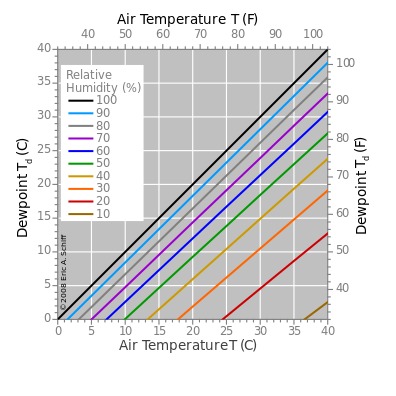
I suspect I might get a bit obsessed checking our hygrometer in The Lodge, as we try to beat the problems we're inheriting. Condensation appears on walls when the temperature of the walls is at or below the dew point – the temperature that water vapour in the air condenses into liquid water. As this is directly affected by the humidity of the atmosphere, along with reducing the humidity, warming up The Lodge itself will be another thing high on the to-do list.

The Wikipedia entry on dew point has a handy graph to show dew point calculation:


If graphs and calculations aren't your thing, you can also buy digital hygrometers with a dew point indicator built in, like this one: TFA-Dostmann Digital Hygrometer with dew point indicator.

Meanwhile, if you’re keen to read even more about condensation, here’s an article by Pete, about condensation in old buildings. 

And if you just want to get rid of mould, click here for our recommendation.